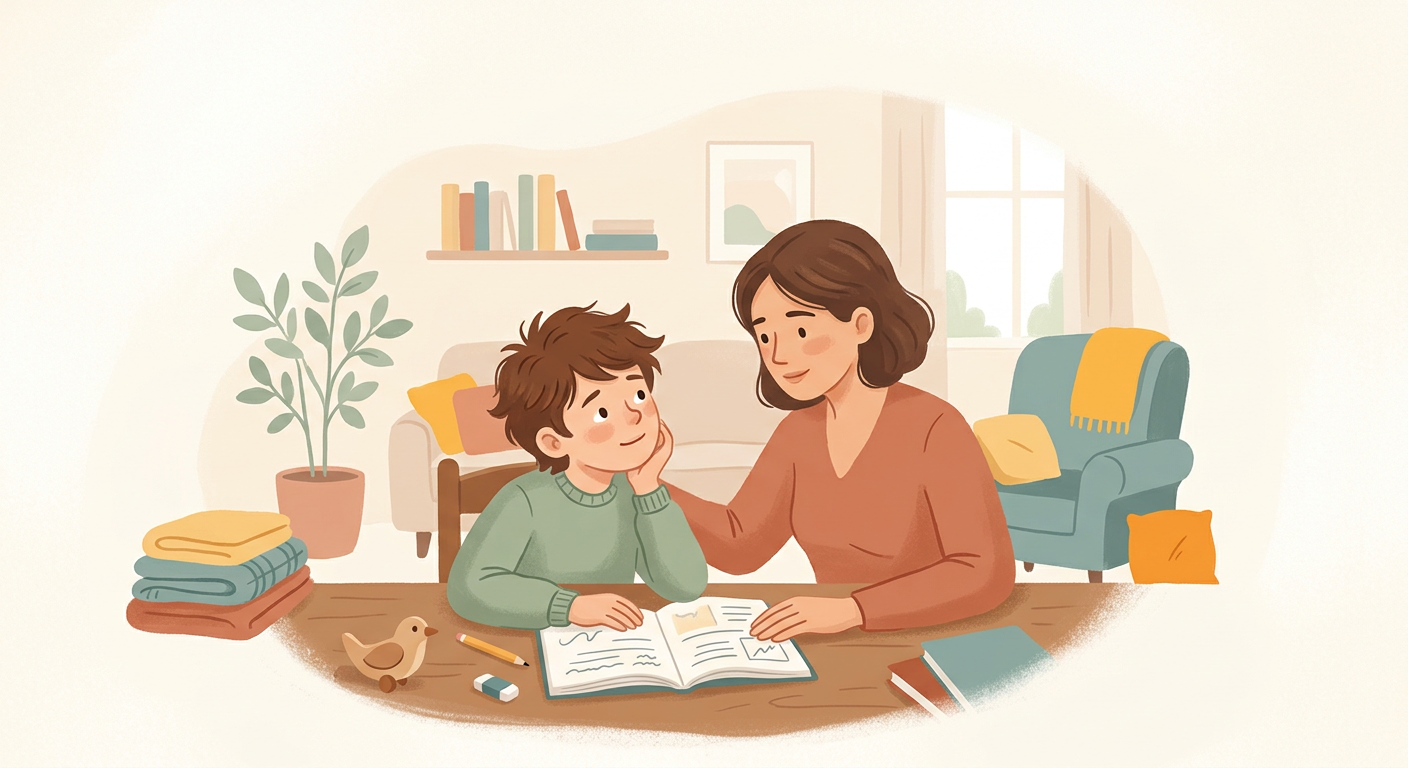
Your 10-year-old daughter has been staring at her homework for an hour, doing nothing. She asks for your help. You...
This is just 1 of 100+ questions in the Parenting Test
Want to know your real style and get a full diagnosis? Takes 2 minutes, free.
Take the Parenting Test →Why this situation matters
Llega la tarde y con ella, la hora de los deberes. Para muchos padres y madres, este momento puede convertirse en una verdadera prueba de paciencia y estrategia. Ver a tu hijo o hija bloqueado frente a un ejercicio, o notarle distraído después de un largo día de colegio, es una situación familiar. Es natural querer intervenir, ofrecer soluciones rápidas o incluso tomar las riendas para evitarles un mal rato o la frustración.
Sin embargo, la forma en que abordamos este desafío tiene un impacto significativo en el desarrollo de la autonomía escolar de nuestros hijos. Ayudarlos demasiado puede impedirles desarrollar habilidades esenciales como la resolución de problemas, la gestión del tiempo y la perseverancia. Por otro lado, no ofrecer el apoyo adecuado puede llevar a sentimientos de abandono o incompetencia. Encontrar el equilibrio justo es clave para fomentar su independencia y su confianza en sí mismos.
La clave está en ser un facilitador, no un ejecutor. Tu papel es guiarlos para que encuentren sus propias soluciones, no dárselas hechas. Esto fortalece su capacidad de aprendizaje y les enseña que los desafíos son una oportunidad para crecer. ¿Estás listo para descubrir cómo reaccionar de la manera más constructiva en esta situación tan común?
The possible answers
Tap the option you would choose
What the experts say
Wendy S. Grolnick
Professor of Psychology, Clark University
“Well-calibrated support, which offers autonomy and structures the task, is key to intrinsic motivation; excessive control or a complete lack of involvement sabotages it.”
Lawrence Steinberg
Professor of Psychology, Temple University
“Authoritative parents balance warmth and control, setting clear limits and providing help when necessary, but always with the goal of autonomy.”
Alfie Kohn
Educator and author
“Help shouldn't be about the child 'getting things right', but about them learning. This means support that is gradually withdrawn.”
Devil's advocate
Common objection
But if I explain the first one, won't I end up doing all of them? It's a 'slippery slope' to unlimited help.
Why it falls short
Not necessarily. The key is to explain only the first one and then step back, observing if she has understood the strategy. The idea is to empower her, not make her dependent. You set the pattern, she applies the rule.
This is just 1 of 100+ questions in the Parenting Test
Want to know your real style and get a full diagnosis? Takes 2 minutes, free.
Take the Parenting Test →Related questions
Your 9-year-old asks you to "check" their essay. It's really bad. If they hand it in like this, they'll fail. You…
Apoyo andamiado
Your 16-year-old son has failed four subjects. He says 'the system is rubbish.'
Valida queja + devuelve agencia + mantén horizonte.
Your 9-year-old brings home bad grades and says, 'The teacher has it in for me.'
Primero escucha, luego plan.
Part of the Fami ecosystem
Sites made by families, for families. Start with the two most loved:
The task manager that coordinates your whole family — without the stress.
Visit →famiEduca.comA platform where children learn on their own, the fun way.
Visit →Worldwide guide of destinations and points of interest for family travel.
Restaurants where great food is also for the kids.
Challenges and games to rediscover the joy of playing together.
Easy recipes to cook with the little ones.
Films handpicked to watch as a family.
Reads for small big readers.