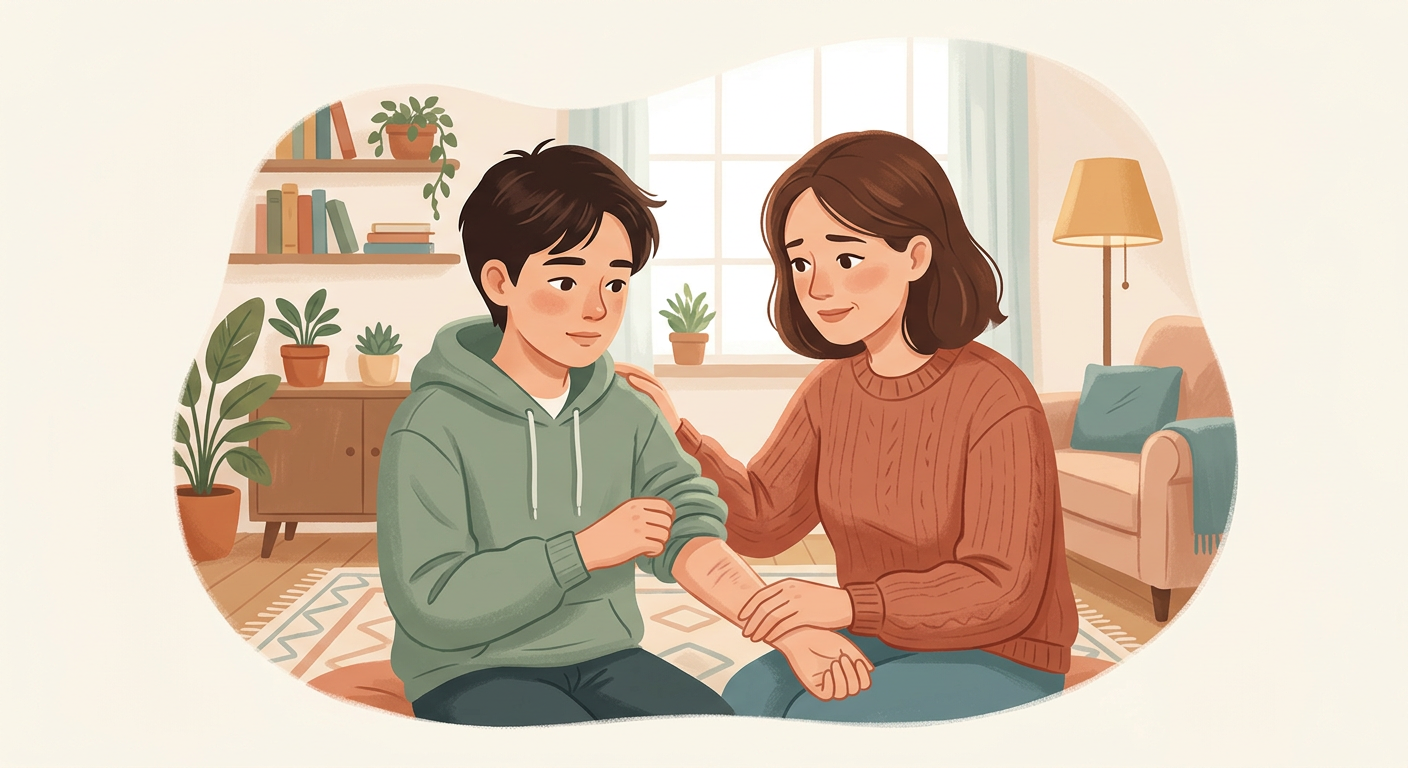
Your 15-year-old daughter shows you marks on her arm. She says she 'sometimes cuts herself.' You...
This is just 1 of 100+ questions in the Parenting Test
Want to know your real style and get a full diagnosis? Takes 2 minutes, free.
Take the Parenting Test →Why this situation matters
Cuando tu hija adolescente te confía que se está autolesionando, te encuentras en una de las situaciones más delicadas y con mayor potencial para fortalecer o dañar vuestro vínculo. La forma en que respondas en este momento es crucial, no solo para su seguridad inmediata, sino para su bienestar emocional a largo plazo y la percepción que tendrá de ti como fuente de apoyo. Tu reacción puede abrir la puerta a un diálogo honesto o cerrarla por completo.
Es natural sentir una mezcla de miedo, confusión, enojo o culpa. Sin embargo, recordar que tu hija ha dado un paso valiente al compartir esto contigo es fundamental. La adolescencia es una etapa de intensos cambios emocionales y cognitivos, donde la búsqueda de identidad y la presión social pueden llevar a comportamientos complejos. Mantener la calma y mostrar empatía son los primeros pilares para manejar esta situación compleja. La gestión de estas emociones requiere sensibilidad y un enfoque estratégico, ya que de lo contrario, una reacción impulsiva o poco informada podría empeorar la situación o dificultar que tu hija busque ayuda.
Comprender el impacto de tu respuesta es entender que no solo se trata de un incidente aislado, sino de la manifestación de un dolor más profundo que necesita ser abordado. Tu papel es fundamental en guiarla hacia el apoyo adecuado mientras mantienes vuestra relación. ¿Estás preparado para descubrir cómo navegar esta situación de la manera más efectiva y cariñosa?
The possible answers
Tap the option you would choose
What the experts say
Dr. Daniel Siegel
Neuropsychiatrist and author
“Maintaining a receptive presence and validating an adolescent's internal experience, even pain, is fundamental to their safety and emotional development.”
NICE (National Institute for Health and Care Excellence)
Clinical practice guidelines
“The initial response to self-harm should focus on safety, risk assessment, and referral to specialist mental health services, with a compassionate approach.”
Drs. Adele Faber y Elaine Mazlish
Experts in family communication
“When a child confides something painful to you, the first step is to listen and acknowledge their feelings. The mere act of being heard is tremendously healing.”
Devil's advocate
Common objection
Isn't going straight to a professional an overreaction? Maybe she's just seeking attention, or I can handle it myself by talking to her.
Why it falls short
While talking is crucial, self-harm is a serious sign of distress that requires expert evaluation. A professional not only manages risk but also offers strategies and a safe space that parents, due to their role, cannot always provide on their own.
This is just 1 of 100+ questions in the Parenting Test
Want to know your real style and get a full diagnosis? Takes 2 minutes, free.
Take the Parenting Test →Related questions
Your 11-year-old daughter casually mentions that an older cousin 'sometimes tickles her in weird ways.' You…
Validar, escuchar, proteger
Another parent from school tells you there are some 'weird' photos circulating in a kids' WhatsApp group. Your 11-year-old son is in the group. You...
Diálogo y acompañamiento digital
Part of the Fami ecosystem
Sites made by families, for families. Start with the two most loved:
The task manager that coordinates your whole family — without the stress.
Visit →famiEduca.comA platform where children learn on their own, the fun way.
Visit →Worldwide guide of destinations and points of interest for family travel.
Restaurants where great food is also for the kids.
Challenges and games to rediscover the joy of playing together.
Easy recipes to cook with the little ones.
Films handpicked to watch as a family.
Reads for small big readers.