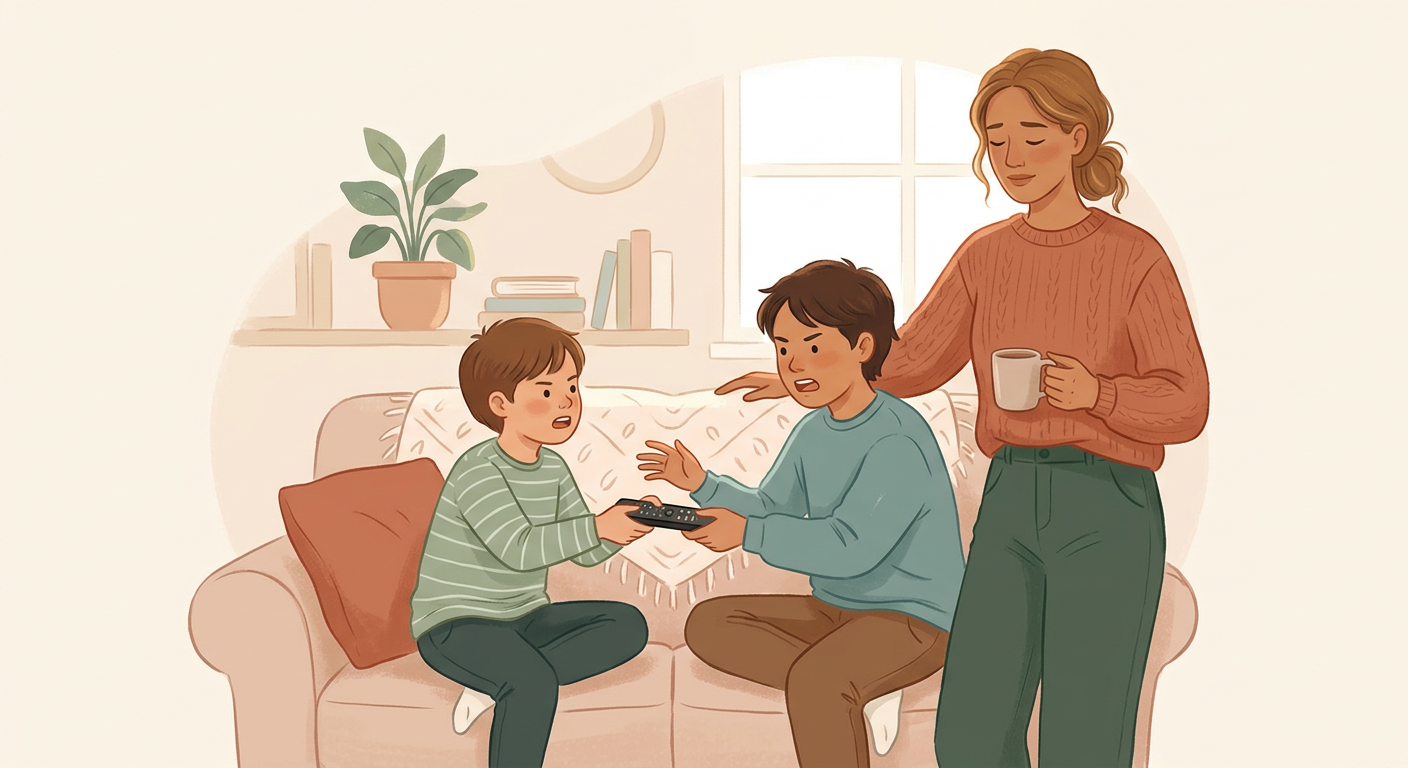
Your kids (9 and 11) are fighting over the remote for the umpteenth time. You…
This is just 1 of 100+ questions in the Parenting Test
Want to know your real style and get a full diagnosis? Takes 2 minutes, free.
Take the Parenting Test →Why this situation matters
La dinámica entre hermanos puede ser una fuente constante de desafíos, especialmente cuando involucra objetos o actividades compartidas como la televisión. Las discusiones por el control remoto no son solo peleas triviales; a menudo, son una forma de que los niños exploren el poder, la autonomía y aprendan a negociar sus deseos dentro de un entorno familiar. Cómo reaccionamos como padres en estos momentos puede tener un impacto significativo en el desarrollo de estas habilidades sociales.
Es natural que los niños busquen atención y deseen tener el control, y estas peleas son una oportunidad para enseñarles sobre el respeto mutuo, la empatía y la resolución de conflictos. Su intervención no solo busca calmar la situación inmediata, sino también modelar cómo afrontar las diferencias de opinión de una manera constructiva. Pensar en por qué sus hijos están discutiendo realmente, y no solo lo que están discutiendo, le da una perspectiva más profunda sobre sus necesidades.
Comprender el balance entre intervenir para enseñar y permitirles que busquen sus propias soluciones es clave. Cada elección tiene implicaciones en cómo sus hijos aprenderán a manejar las frustraciones y a valorar las relaciones. Es importante ver estas interacciones como momentos educativos. Si desea explorar cómo su enfoque actual afecta la dinámica familiar y el desarrollo de sus hijos, le invito a continuar.
The possible answers
These are the options you'll see in the test. Each one measures something different — we won't tell you which is best here (that's what the test is for 😉).
- ATurn off the TV “until you learn to share.”
- BYou decide what to watch, and that’s final.
- CGive each of them a different screen.
- DGo to another room and let them sort it out.
What the experts say
Adele Faber & Elaine Mazlish
Authors of 'Siblings Without Rivalry'
“When parents act as judges, more conflict is likely to erupt. When the problem is the children's, the solution should be the children's.”
Diana Baumrind
Developmental psychologist, University of California, Berkeley
“The authoritative parenting style combines high demands with high responsiveness, setting clear boundaries while fostering the child's autonomy and reasoning.”
Dan Siegel
Child neuropsychiatrist, author of 'The Whole-Brain Child'
“Teaching children to reflect on their actions and their consequences is key to developing empathy and emotional intelligence.”
Devil's advocate
Common objection
But in the end, it's me who has to turn off the TV, isn't that still a form of punishment?
Why it falls short
While it does involve deprivation, the key difference is that it's a logical consequence, not a punitive one. The TV is taken away because they can't use it properly, not out of mere caprice, and the path to getting it back (by resolving the conflict) is open and in their hands. It's a lesson, not just an annoyance.
This is just 1 of 100+ questions in the Parenting Test
Want to know your real style and get a full diagnosis? Takes 2 minutes, free.
Take the Parenting Test →Related questions
Your older child (12) tells you privately: "You're always softer with my sister." They have a point. You...
Validar y preguntar
Your two children (8 and 10) are yelling at each other over who gets the TV remote.
Retira el premio; delega la solución.
You've just had your second child. Your older child (5) brings a toy car to the baby… and squashes it against their face. "I wanted them to play." You...
Implicación empática y responsabilidad
Part of the Fami ecosystem
Sites made by families, for families. Start with the two most loved:
The task manager that coordinates your whole family — without the stress.
Visit →famiEduca.comA platform where children learn on their own, the fun way.
Visit →Worldwide guide of destinations and points of interest for family travel.
Restaurants where great food is also for the kids.
Challenges and games to rediscover the joy of playing together.
Easy recipes to cook with the little ones.
Films handpicked to watch as a family.
Reads for small big readers.