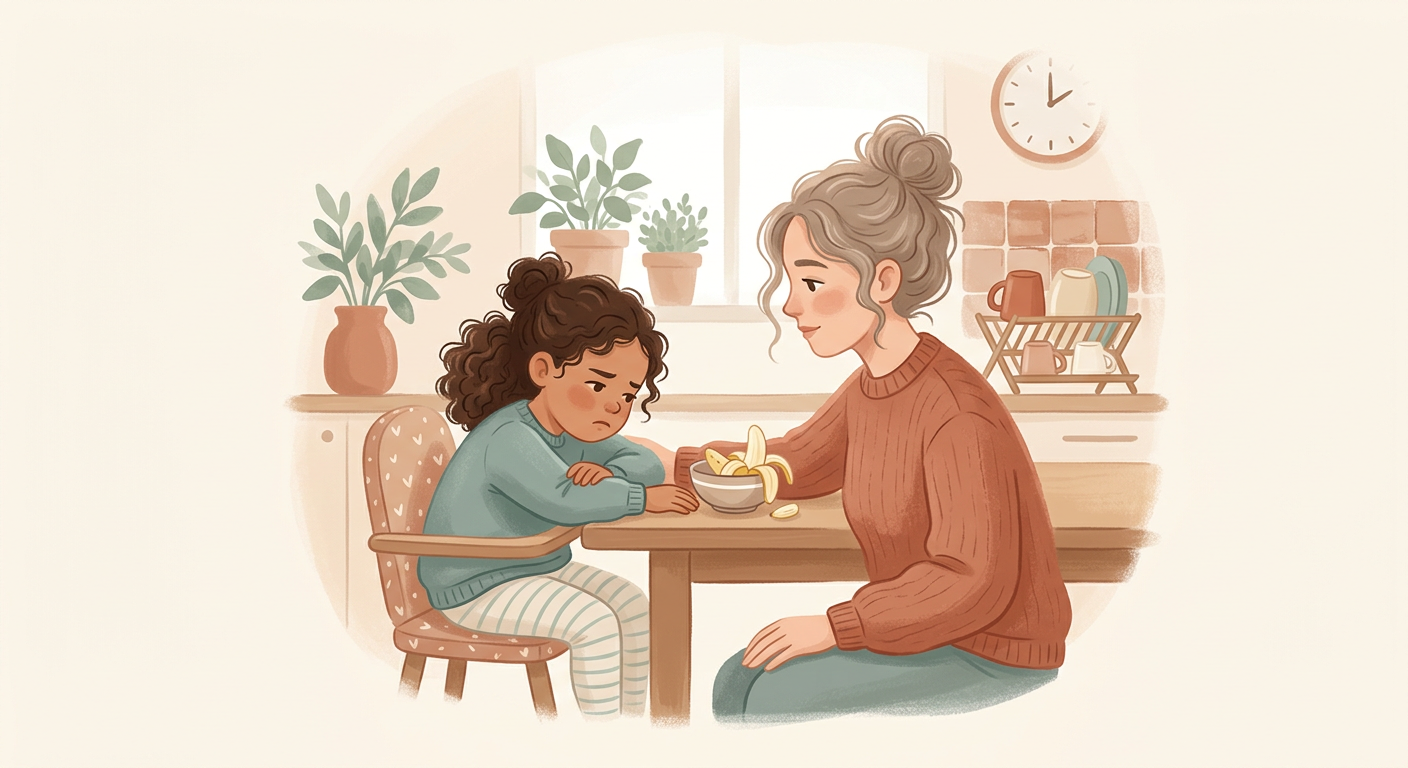
Your 4-year-old has been in a 25-minute loop because you cut his banana, and "he wanted it whole." You even tried sticking it back together with a fork. It didn't work. You...
This is just 1 of 100+ questions in the Parenting Test
Want to know your real style and get a full diagnosis? Takes 2 minutes, free.
Take the Parenting Test →Why this situation matters
Every parent has faced that moment: a seemingly trivial incident triggers an intense emotional reaction in their child. The 'banana incident' is a classic example of how quickly a little one can become overwhelmed by a minor disappointment, especially when their expectations aren't met exactly as imagined.
These situations, while frustrating, are actually valuable opportunities. How you respond can significantly influence your child's emotional regulation skills and their ability to cope with future frustrations. Your reaction helps them understand that it's okay to feel upset, but also that there are constructive ways to move through those feelings. It's about balancing empathy with setting appropriate boundaries and guiding them towards independence.
Understanding your go-to response in these high-stakes moments can reveal a lot about your parenting style and its impact on your child's development. Let's explore how you typically handle these emotional outbursts and what that might mean for your little one's growth.
The possible answers
These are the options you'll see in the test. Each one measures something different — we won't tell you which is best here (that's what the test is for 😉).
- AYou (gently) laugh and offer him another whole banana.
- B"No banana then, you'll just have to deal with it."
- CYou rush out to buy another banana.
- DYou lock yourself in the bathroom to breathe.
What the experts say
Diana Baumrind
Developmental Psychologist, University of California, Berkeley
“Authoritative parents, by combining high expectations with high responsiveness, foster competent and secure children.”
Daniel Siegel
Clinical Neuropsychiatrist, co-author of 'The Whole-Brain Child'
“Helping a child 'name to tame' their emotions and offering a solution allows them to remain within their emotional 'window of tolerance.'”
Adele Faber & Elaine Mazlish
Family communication experts, authors of 'How to Talk So Kids Will Listen & Listen So Kids Will Talk'
“Validating children's feelings is the first step in helping them handle difficult situations, even when we can't fulfill their demands.”
Devil's advocate
Common objection
Pero si me río, el niño pensará que me estoy burlando de él o que no tomo en serio su dolor por el plátano. Y darle otro es ceder al final, ¿no?
Why it falls short
Una sonrisa o risa ligera, sin sarcasmo, puede aligerar la tensión y mostrar que la situación no es una catástrofe. Ofrecer una alternativa viable no es ceder sin más, sino reconocer su disgusto mientras le brindas una forma constructiva de resolver el problema, reestableciendo el control de una manera positiva.
This is just 1 of 100+ questions in the Parenting Test
Want to know your real style and get a full diagnosis? Takes 2 minutes, free.
Take the Parenting Test →Related questions
At the supermarket, your 5-year-old throws herself on the floor, screaming because you won't buy her a Kinder Surprise. People are staring. You...
Validar y contener
Your 2-year-old throws themselves onto the supermarket floor because you won't buy them cookies. People are staring.
Rabieta = co-regulación, no negociación.
Part of the Fami ecosystem
Sites made by families, for families. Start with the two most loved:
The task manager that coordinates your whole family — without the stress.
Visit →famiEduca.comA platform where children learn on their own, the fun way.
Visit →Worldwide guide of destinations and points of interest for family travel.
Restaurants where great food is also for the kids.
Challenges and games to rediscover the joy of playing together.
Easy recipes to cook with the little ones.
Films handpicked to watch as a family.
Reads for small big readers.