Your 6-year-old daughter drops this bombshell at dinner: "Mom, why do you get to look at your phone at the table, but I don't?" Awkward silence. You...
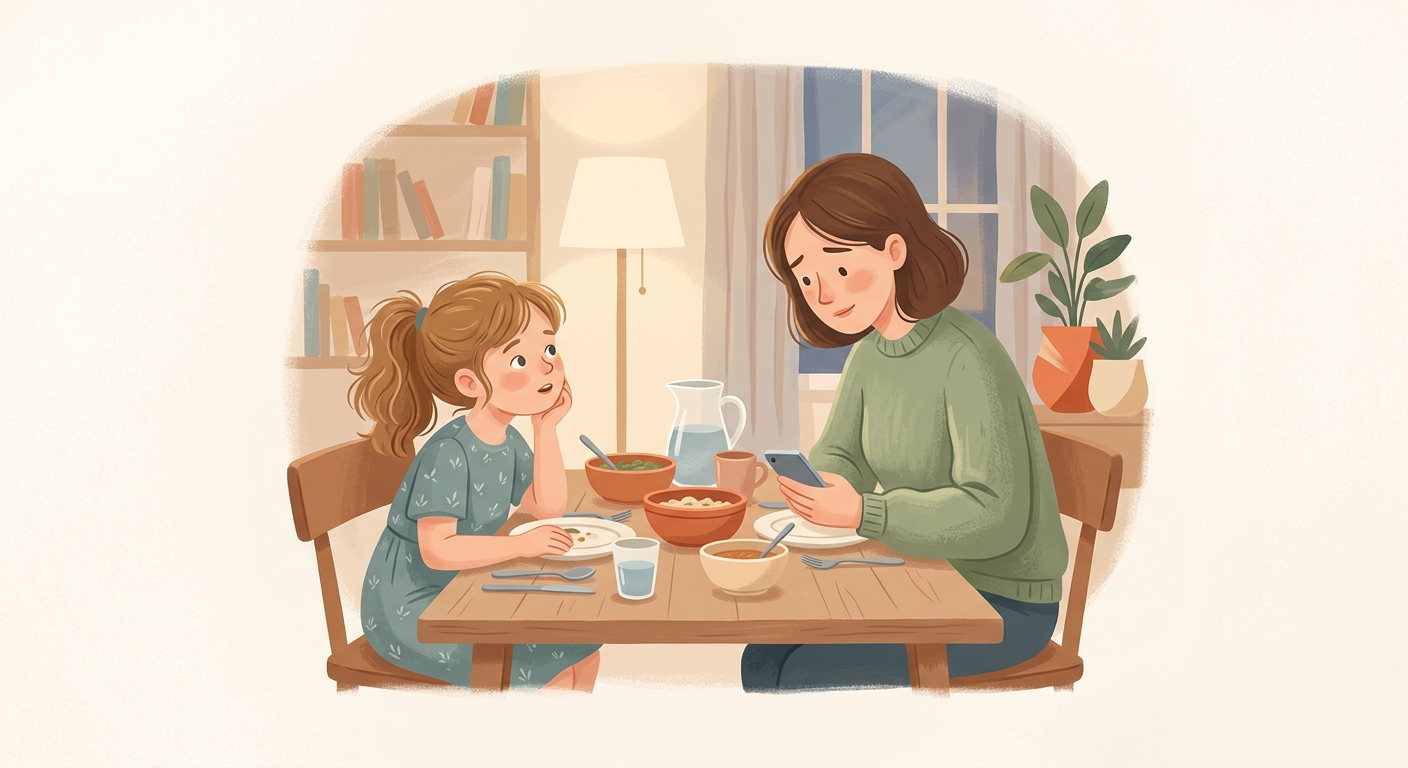
This is just 1 of 100+ questions in the Parenting Test
Want to know your real style and get a full diagnosis? Takes 2 minutes, free.
Take the Parenting Test →Why this situation matters
Como padres, navegamos un mar constante de preguntas y observaciones de nuestros hijos. A menudo, estas preguntas, formuladas con la inocencia y la perspicacia de la infancia, nos confrontan con nuestras propias reglas y hábitos, especialmente cuando se trata de la tecnología. La situación de las pantallas en la mesa es un claro ejemplo de este desafío moderno. Los niños, al observar nuestras acciones, absorben más información de lo que a veces imaginamos, y rápidamente señalan las inconsistencias entre lo que predicamos y lo que practicamos.
El desarrollo infantil se basa en la observación y la imitación. Cuando los niños ven a sus padres haciendo algo que a ellos se les prohíbe, pueden desarrollar sentimientos de injusticia o confusión, lo que afecta su comprensión de los límites y la equidad. Responder a estas situaciones no es solo sobre dar una explicación, sino sobre validar sus sentimientos y, en ocasiones, estar dispuestos a revisar nuestras propias normas de conducta.
La forma en que manejamos estos momentos no solo moldea su comprensión de las reglas familiares, sino que también establece las bases para futuras conversaciones sobre límites, respeto y el uso consciente de la tecnología. Reflexionar sobre estas interacciones es clave para desarrollar una crianza coherente y efectiva. ¿Estás listo para ver cómo tu estilo de crianza se alinea con este tipo de dilemas cotidianos?
The possible answers
These are the options you'll see in the test. Each one measures something different — we won't tell you which is best here (that's what the test is for 😉).
- A"Because I'm an adult, full stop."
- B"You're right. I'll put it away, and we'll make it a rule for everyone."
- C"It's work" (it wasn't)
- DLet her use it at the table too.
What the experts say
Albert Bandura
Psychologist, Social Learning Theory
“A large part of human behavior is learned through observation, by imitating others, especially authority figures.”
Diana Baumrind
Developmental Psychologist, parenting styles
“Authoritative parents set clear limits but are responsive to their children's concerns, explaining the reasons behind rules.”
Alfie Kohn
Author, education and parenting
“More than obedience, what we need to foster in children is common sense and an understanding of why certain actions are beneficial or harmful.”
Devil's advocate
Common objection
Do I really have to justify myself to my 6-year-old daughter? And now I have to give up looking at my phone too, because of her?
Why it falls short
It's not about 'justifying yourself' to her, but about modeling flexibility and consistency. By listening to her critique, you not only strengthen her observational and argumentative skills, but also demonstrate that rules are there to improve coexistence and that example is everything.
This is just 1 of 100+ questions in the Parenting Test
Want to know your real style and get a full diagnosis? Takes 2 minutes, free.
Take the Parenting Test →Related questions
You agreed on 30 minutes of tablet time. It’s been 45, and you ask them to turn it off. 'Just five more minutes, please.' You...
Límites claros, Previsibilidad activa
You catch your 12-year-old watching a YouTuber using swear words and making suggestive jokes. You...
Diálogo, guía, alfabetización mediática
Your 11-year-old asks for Fortnite because 'all their friends have it.'
Contrato escrito > prohibición > barra libre.
Your 11-year-old asks for Fortnite because "EVERYONE in class plays it." You've confirmed with two other parents that only three actually do. You...
Mediación activa
Your 5-year-old asks for the tablet as soon as they walk in the door. They already get 30 minutes a day and want more.
Pantalla con tope predecible > prohibición o barra libre.
Part of the Fami ecosystem
Sites made by families, for families. Start with the two most loved:
The task manager that coordinates your whole family — without the stress.
Visit →famiEduca.comA platform where children learn on their own, the fun way.
Visit →Worldwide guide of destinations and points of interest for family travel.
Restaurants where great food is also for the kids.
Challenges and games to rediscover the joy of playing together.
Easy recipes to cook with the little ones.
Films handpicked to watch as a family.
Reads for small big readers.