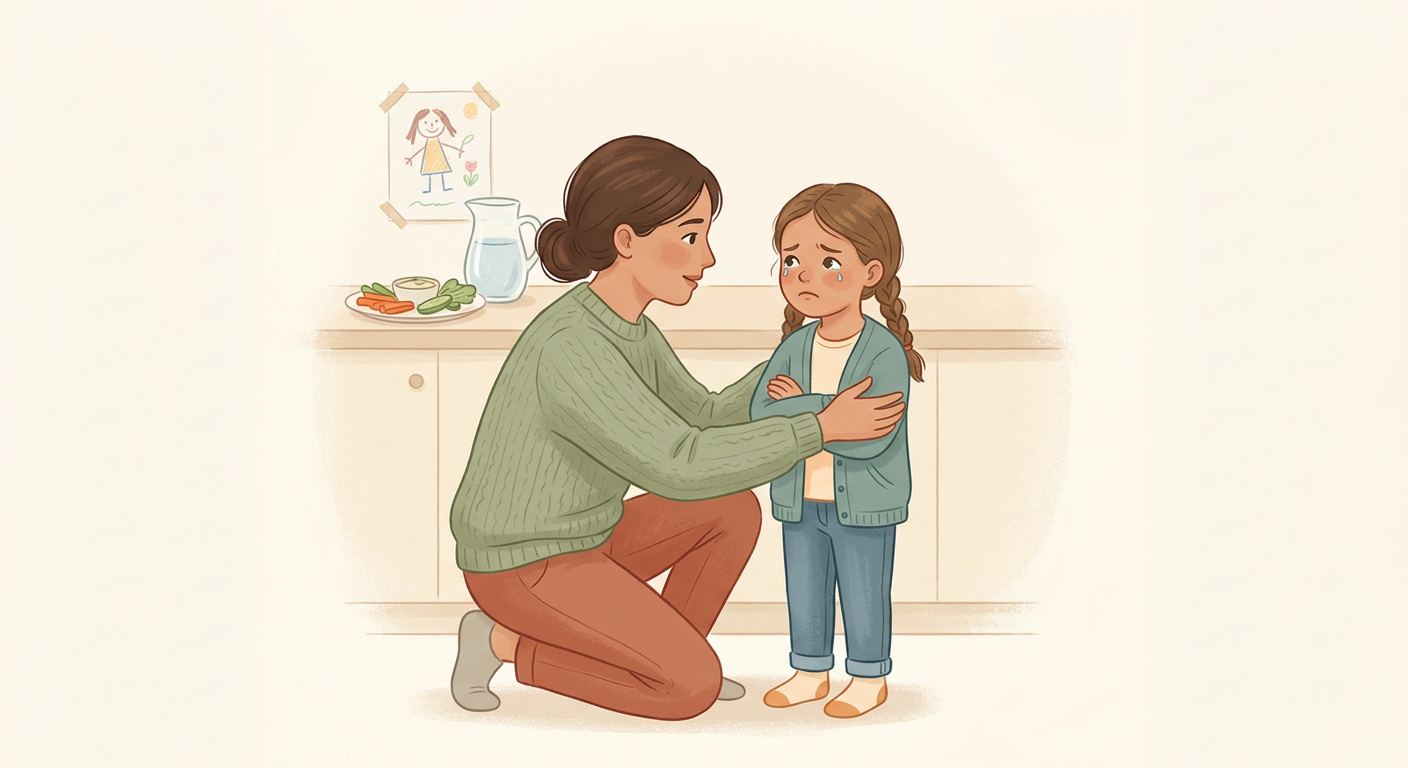
Your 6-year-old tells you 'I hate you' because you've said no to ice cream before dinner. You...
This is just 1 of 100+ questions in the Parenting Test
Want to know your real style and get a full diagnosis? Takes 2 minutes, free.
Take the Parenting Test →Why this situation matters
Como padres, esas palabras, "Te odio", especialmente cuando vienen de nuestros pequeños, pueden golpearnos en lo más profundo. Es una situación que nos desafía a mantener la calma y a reaccionar de una manera que sea constructiva para su desarrollo emocional, incluso cuando nuestras propias emociones están a flor de piel.
La forma en que manejamos estos momentos no solo moldea su comportamiento futuro, sino que también les enseña sobre la gestión de la frustración y la expresión de emociones intensas. Es una oportunidad para validar sus sentimientos, sin ceder en los límites que consideramos importantes para su bienestar. Es clave recordar que, a menudo, estas expresiones son un intento de comunicar una emoción abrumadora, no un ataque personal.
Entender cómo responder adecuadamente puede reforzar tu estilo de crianza y ayudar a tu hijo a desarrollar una mejor inteligencia emocional, transformando un momento difícil en una lección valiosa. Descubre cómo tu reacción en esta situación puede influir en su crecimiento.
The possible answers
Tap the option you would choose
What the experts say
Diana Baumrind
Developmental Psychologist, University of California, Berkeley
“The authoritative parenting style is associated with children who have higher social competence, maturity, and self-esteem.”
Haim Ginott
Child psychologist and author
“Emotions must be expressed in words, not in actions. Validating emotions opens the door to cooperation.”
Daniel Siegel
Neuroscientist and child psychiatrist
“Connect and redirect helps to integrate children's intense emotions with rational thought.”
Devil's advocate
Common objection
But if I tell her 'I understand her anger,' aren't I encouraging her to get angrier? It's like agreeing with her when she's in the wrong.
Why it falls short
On the contrary. Validating your daughter's emotion ('I understand you're upset') helps her feel seen and less alone in her frustration, defusing some of the intensity. Ignoring or suppressing anger usually makes it grow. Once the emotion is acknowledged, firmness in the boundary ('It's still a no') is easier to accept, or at least to tolerate.
This is just 1 of 100+ questions in the Parenting Test
Want to know your real style and get a full diagnosis? Takes 2 minutes, free.
Take the Parenting Test →Related questions
Your 2-year-old child hits you in the face playfully. You...
Límites claros y cálidos
Your 22-month-old has discovered that throwing her spoon from her high chair is the funniest thing ever. She's thrown 7 spoons. You...
Extinción conductual, Consecuencia natural
You find a half-empty vodka bottle under your 15-year-old daughter's bed.
Entender antes de sentenciar; mantén el mapa.
Your 12-year-old child yells 'I hate you!' because you've told them they can't go to a party.
Límite firme + emoción acogida ≠ permisividad.
You get home exhausted and find the living room wall painted with permanent marker. Your 6-year-old looks at you in silence. You…
Límites claros, reparación
Your 6-year-old daughter hits you when you tell her 'no' to having sweets before dinner.
Contención física sí; violencia no.
Part of the Fami ecosystem
Sites made by families, for families. Start with the two most loved:
The task manager that coordinates your whole family — without the stress.
Visit →famiEduca.comA platform where children learn on their own, the fun way.
Visit →Worldwide guide of destinations and points of interest for family travel.
Restaurants where great food is also for the kids.
Challenges and games to rediscover the joy of playing together.
Easy recipes to cook with the little ones.
Films handpicked to watch as a family.
Reads for small big readers.