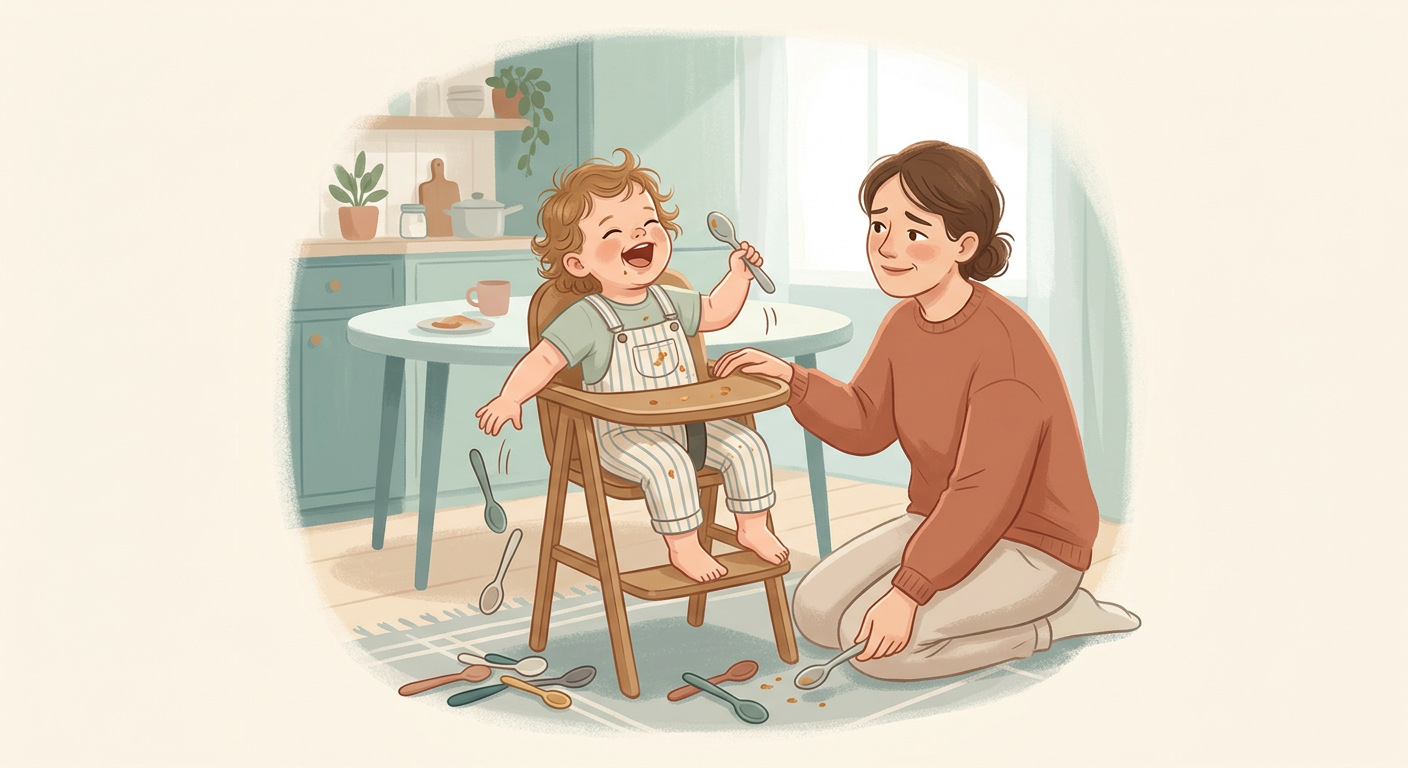
Your 22-month-old has discovered that throwing her spoon from her high chair is the funniest thing ever. She's thrown 7 spoons. You...
This is just 1 of 100+ questions in the Parenting Test
Want to know your real style and get a full diagnosis? Takes 2 minutes, free.
Take the Parenting Test →Why this situation matters
Esas primeras etapas de la infancia están llenas de descubrimientos, y a veces, esos descubrimientos incluyen acciones que pueden ponernos a prueba como padres. Cuando tu pequeño empieza a tirar objetos repetidamente, no es necesariamente una señal de desafío, sino a menudo una exploración fascinante de la causa y el efecto. Están aprendiendo sobre la gravedad, sobre su propia capacidad para generar una reacción y, a veces, sobre cómo captar tu atención.
La forma en que respondemos a estos comportamientos tiene un impacto significativo no solo en cómo gestionamos la situación en el momento, sino también en el desarrollo de los límites, la comunicación y la comprensión de las expectativas. Es una oportunidad para enseñarle a tu hijo sobre las consecuencias, la paciencia y las interacciones apropiadas, todo ello mientras navegan por sus propias emociones y las tuyas.
Entender la psicología detrás de por qué un niño tira cosas puede ayudarte a reaccionar de una manera que fomente un crecimiento saludable y establezca un precedente positivo para futuras interacciones. ¿Cómo manejas este momento con tu pequeño explorador?
The possible answers
Tap the option you would choose
What the experts say
B.F. Skinner
Behavioral Psychologist
“Intermittent reinforcement produces behavior that is very persistent and difficult to extinguish.”
Daniel J. Siegel
Neuroscientist, author
“Emotional attunement (tuning into our children's mental state) is key, but without reinforcing undesirable behaviors.”
Carol S. Dweck
Psychologist, author
“Effort and strategy are the best subjects for feedback, not the outcome of a 'bad action'.”
Devil's advocate
Common objection
But if I don't say anything, she'll keep doing it. How will she learn if I don't say 'no' or get angry?
Why it falls short
Young children learn more from direct consequences and consistency than from lectures or emotional reactions. Withdrawing attention and the 'fun' from the act is itself a clear consequence. Your silence communicates that it's not an interesting game with your involvement.
This is just 1 of 100+ questions in the Parenting Test
Want to know your real style and get a full diagnosis? Takes 2 minutes, free.
Take the Parenting Test →Related questions
Your 2-year-old child hits you in the face playfully. You...
Límites claros y cálidos
Your 6-year-old tells you 'I hate you' because you've said no to ice cream before dinner. You...
Validar, Limitar, Sostener
You find a half-empty vodka bottle under your 15-year-old daughter's bed.
Entender antes de sentenciar; mantén el mapa.
Your 12-year-old child yells 'I hate you!' because you've told them they can't go to a party.
Límite firme + emoción acogida ≠ permisividad.
You get home exhausted and find the living room wall painted with permanent marker. Your 6-year-old looks at you in silence. You…
Límites claros, reparación
Your 6-year-old daughter hits you when you tell her 'no' to having sweets before dinner.
Contención física sí; violencia no.
Part of the Fami ecosystem
Sites made by families, for families. Start with the two most loved:
The task manager that coordinates your whole family — without the stress.
Visit →famiEduca.comA platform where children learn on their own, the fun way.
Visit →Worldwide guide of destinations and points of interest for family travel.
Restaurants where great food is also for the kids.
Challenges and games to rediscover the joy of playing together.
Easy recipes to cook with the little ones.
Films handpicked to watch as a family.
Reads for small big readers.