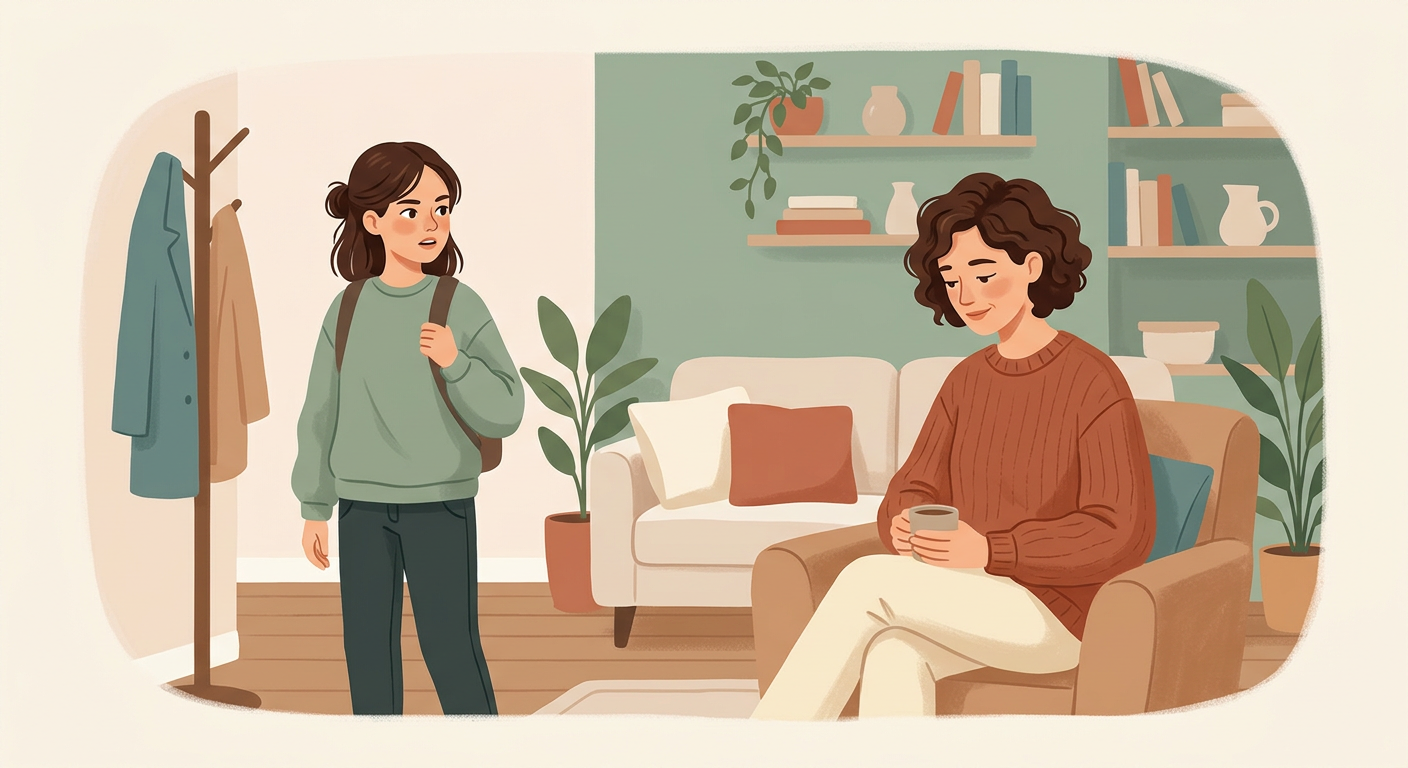
Your 14-year-old daughter asks you to drop her off at the corner, not right at the school gates, because she doesn't want to be seen with you. You...
This is just 1 of 100+ questions in the Parenting Test
Want to know your real style and get a full diagnosis? Takes 2 minutes, free.
Take the Parenting Test →Why this situation matters
Es completamente normal que los adolescentes busquen su independencia y empiecen a establecer su propia identidad fuera del círculo familiar. Quieren encajar con sus compañeros y, a veces, la presencia de sus padres puede percibirse como un obstáculo para esa meta.
Esta etapa de desarrollo se caracteriza por una mayor conciencia de la imagen social y un deseo de autonomía. Las reacciones de los padres en estas situaciones pueden influir significativamente en la relación que tienen con sus hijos, la confianza mutua y la forma en que el adolescente aprende a manejar situaciones sociales y emocionales.
Entender y manejar estas peticiones de independencia con empatía y sabiduría es clave para fomentar un desarrollo saludable y mantener una conexión sólida. ¿Cómo responderías tú ante una situación como esta?
The possible answers
Tap the option you would choose
What the experts say
Laurence Steinberg
Developmental Psychologist, Temple University
“Adolescence is a transitional period during which young people seek to separate from parents to form their own identity. Parents should offer warm support with clear boundaries, but without excessively controlling the adolescent's social sphere.”
Daniel Siegel
Neuropsychiatrist, University of California
“Validating adolescents' emotions and subjective experiences, even when they seem trivial, is crucial for their brain and emotional development. Ignoring or ridiculing their needs for social belonging is counterproductive.”
Diana Baumrind
Developmental Psychologist, University of California
“The authoritative parenting style (demanding, supportive) promotes competence in adolescents. It combines high expectations with high responsiveness, understanding and adapting to their changing needs.”
Devil's advocate
Common objection
But what if I always give her what she wants? Am I not giving in too much and raising a selfish person who only thinks of herself?
Why it falls short
No. There's a difference between giving in and validating. Respecting these types of requests is not giving a blank cheque, but rather acknowledging their developmental need for autonomy and belonging. This is part of teaching them to negotiate and express their needs in a healthy way, with the security of being heard. Fostering self-esteem is not the same as fostering selfishness.
This is just 1 of 100+ questions in the Parenting Test
Want to know your real style and get a full diagnosis? Takes 2 minutes, free.
Take the Parenting Test →Related questions
Your teenager fails 4 subjects. You...
Autonomía con límites
Your 17-year-old comes home from a party. They smell of alcohol. They're walking fine and you picked them up in their friend's dad's car (the friend wasn't driving). You...
Diálogo retrasado, Límites claros
Your 15-year-old daughter arrives home an hour late from an outing and didn't answer her phone. You...
Diálogo, Límites Respetuosos
Your 15-year-old tells you: "I'm going to Marcos's house to study." You know Marcos isn't home today. You...
Monitoreo transparente, Confianza bidireccional
You accidentally find messages on their phone suggesting they're trying alcohol on weekends. You…
Diálogo indirecto, confianza
Your 16-year-old tells you they're vegan and demands that the entire family change their eating habits.
Apoyo individual + sistema familiar negociado.
Part of the Fami ecosystem
Sites made by families, for families. Start with the two most loved:
The task manager that coordinates your whole family — without the stress.
Visit →famiEduca.comA platform where children learn on their own, the fun way.
Visit →Worldwide guide of destinations and points of interest for family travel.
Restaurants where great food is also for the kids.
Challenges and games to rediscover the joy of playing together.
Easy recipes to cook with the little ones.
Films handpicked to watch as a family.
Reads for small big readers.